

The Impact of Enrichment
Getting Comfortable with Something New: How Indianapolis Zoo Dolphins Learned to Explore Novel Enrichment
What happens when you give a dolphin something it has never seen before?
You might expect curiosity. You might expect hesitation. As I learned during my summer internship at the Indianapolis Zoo, you might see both.
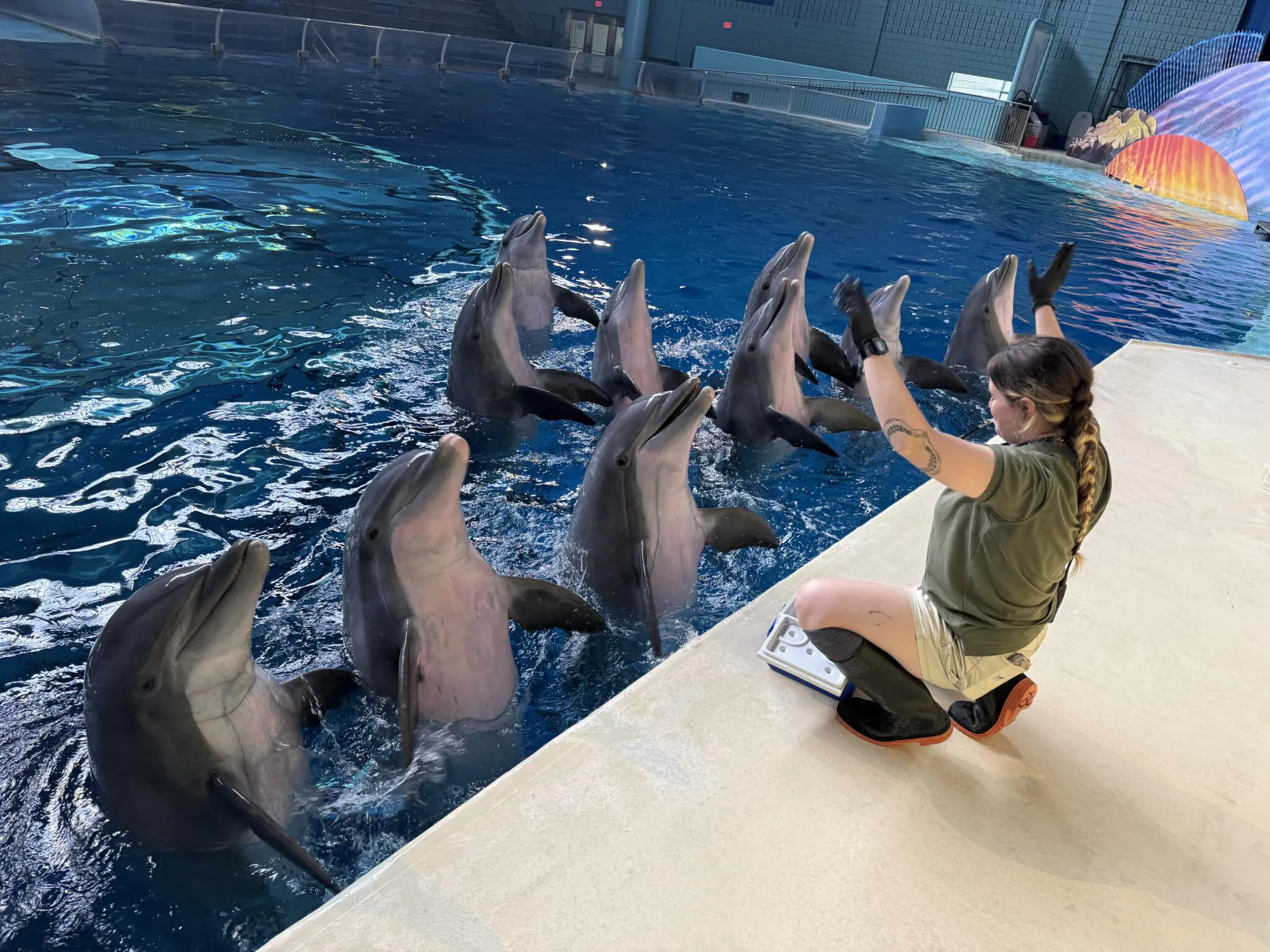
As a Marine Mammal Animal Care Intern, I had the opportunity to work closely with Atlantic bottlenose dolphins, California sea lions, Pacific walruses and gray seals. Throughout my internship, I participated in husbandry, training, enrichment, diet preparation, behavioral observations and guest engagement. One of my favorite experiences was designing and implementing my own internship project that focused on how animals respond to something unfamiliar.
For my project, I introduced a new cooperative foraging device to three of the Zoo’s bottlenose dolphins: Trooper, Orin and Calypso.
More Than Just a Toy
When people hear the word “enrichment,” they may picture an animal playing with a toy. In reality, enrichment has a bigger impact than just being a toy. Environmental enrichment is an important part of animal welfare because it encourages animals to explore, solve problems, make choices and engage in species–appropriate behaviors.
The device I used was a PVC feeder originally designed to encourage cooperative problem–solving. A food reward was secured inside the device, which the dolphin could access by pulling on the handles. Because a device like this had never been introduced to the Indianapolis Zoo dolphins, I could not assume they would immediately know what to do with it, or even want to approach it.
Instead, I focused on helping them become comfortable with the device first.
Taking It One Step at a Time
The process I used is called active desensitization. Desensitization involves gradually introducing an unfamiliar stimulus until it becomes a neutral and familiar part of an animal’s environment. Active desensitization pairs exposure to the new stimulus with positive reinforcement.
The goal was not to force the dolphins to interact with the feeder. Instead, I wanted to build their confidence and encourage them to investigate and interact with it voluntarily.
Previous research helped guide my project. Researchers at Dolphins Plus developed the original cooperative enrichment device and found that dolphins could learn to open it without formal training. Later research at Gulf World incorporated structured conditioning and found high levels of successful cooperation, along with decreases in antagonistic interactions following conditioning.
These studies showed the potential of cooperative enrichment while highlighting the importance of gradual conditioning. For my project, I wanted to see how this process could work with the Indianapolis Zoo dolphins and how their individual differences might influence their responses.
And they definitely responded differently.
Three Dolphins, Three Different Approaches
Trooper immediately approached and investigated the device. He quickly began manipulating the handles and learning how to open the device. He remained engaged throughout the sessions. His confidence and willingness to interact made him the fastest learner of the three.
Orin showed interest shortly after observing Trooper interact with the feeder. Over successive sessions, he increased his approaches and manipulation of the device. With continued positive reinforcement, he consistently engaged voluntarily with the device.
Then there was Calypso.
Calypso was initially more hesitant and cautious when the device was introduced. Rather than expecting her to progress at the same pace as Trooper and Orin, we allowed her to take her time. With continued positive reinforcement and gradual exposure, she began approaching the device more frequently and confidently interacting with it. Eventually, Calypso became much more comfortable with the feeder, just at her own pace.
Seeing these differences was one of the most valuable parts of the project for me. It demonstrated that animal training and care cannot always follow a single formula. An animal’s current context, motivational state and individual history can all influence how it responds to something new.
What I Took Away
One of the biggest lessons I took from this project was the importance of patience and individualization.
It can be tempting to focus only on the final result, but the process of getting there can be just as important. For these dolphins, success was not simply opening the feeder. Success was becoming comfortable enough with something unfamiliar to choose to interact with it voluntarily.
As their confidence increased, the task could be adjusted to provide a greater challenge, such as tightening the caps on the device. This allowed the device to continue encouraging exploration and problem-solving rather than becoming predictable.
The long-term goal is to continue shaping the dolphins’ behaviors toward full cooperative use of the device. Future opportunities could include introducing the feeder to different dolphin pairings and observing how cooperation changes between individuals. Continued monitoring could also help determine how their engagement changes as the device becomes part of their enrichment rotation.
Taking the Experience Forward
Although this project was only one part of my internship, it brought together many of the things I learned throughout my time at the Indianapolis Zoo.
I gained hands on experience with animal husbandry, positive reinforcement, operant conditioning, enrichment, behavioral observation and training for veterinary procedures. I learned how important communication and teamwork are when working with animals and alongside experienced trainers. I also became more comfortable participating in training sessions and talking with guests about the animals in our care.
Most importantly, this internship confirmed that I want to pursue a career working with marine mammals. As I continue studying biology, with a minor in psychology, I hope to carry what I learned at the Zoo into my future studies and career. Understanding animal behavior, recognizing individual differences and learning how to build trust through positive reinforcement are skills I know I will continue developing.
My summer at the Indianapolis Zoo taught me that animal care is not simply about teaching an animal to perform a behavior. It is about understanding the individual animal, recognizing when it is comfortable or uncertain and creating opportunities for it to learn through positive experiences.
Sometimes, progress looks like a dolphin immediately grabbing a rope and figuring out a new device.
And sometimes, it looks like a cautious approach that gets a little closer each day.
Both are progress, and both can teach us something.