

Crayfish on the Edge of Extinction
Crayfish: Weird, Wonderful, and Feeling the Heat
Crayfish, crawfish, crawdads, mudpups… whatever your naming preference, crayfish are a diverse and ecologically important group of species. Found across the globe (with the exception of mainland Africa and Antarctica), crayfish are plentiful in Australia and the United States, with around two-thirds of all crayfish species occurring right here in the United States. While often overlooked in conservation efforts, crayfish are nevertheless highly threatened – and, according to a study recently published in the journal Animal Conservation, with considerable evolutionary history at risk of being lost.
The study, co-authored by Indianapolis Zoo Global Center for Species Survival Freshwater Coordinator Monni Böhm, presents a detailed analysis of the unique evolutionary history of crayfish species combined with their extinction risk to produce the first ever EDGE list of crayfish. The study also focused on how these unique species of crayfish will be impacted by climate change, one of their main threats worldwide alongside invasive species.
What is an EDGE list?
EDGE stands for Evolutionary Distinct and Globally Endangered. EDGE species are threatened species that have few or no close relatives on the Tree of Life. If they disappear, there will be nothing like them in the world!
EDGE lists provide a means to prioritize species for conservation based on their evolutionary distinctiveness and their extinction risk. This method was first developed by researchers at the Zoological Society of London.
Let’s break down evolutionary distinctiveness. It is a way to measure the amount of unique evolutionary history that a species encapsulates. Think of a long branch on the Tree of Life with a single species at the end of it – this species has been distinct from all other species for a long time and therefore is unique and often weird and wonderful, like a platypus or a Chinese giant salamander!
Global Endangerment is based on the extinction risk of the species. Data for this part of EDGE is generally derived from the IUCN Red List of Threatened Species – the world’s foremost authority on the extinction risk of a large variety of species, from mammals and birds to insects and crustaceans, plants and fungi. Crayfish already had been assessed for the Red List in the early 2010s, and were highlighted in a global assessment of the status of freshwater animal species, which showed that 25% of freshwater species (fish, crustaceans, dragonflies and damselflies) are at risk of extinction.
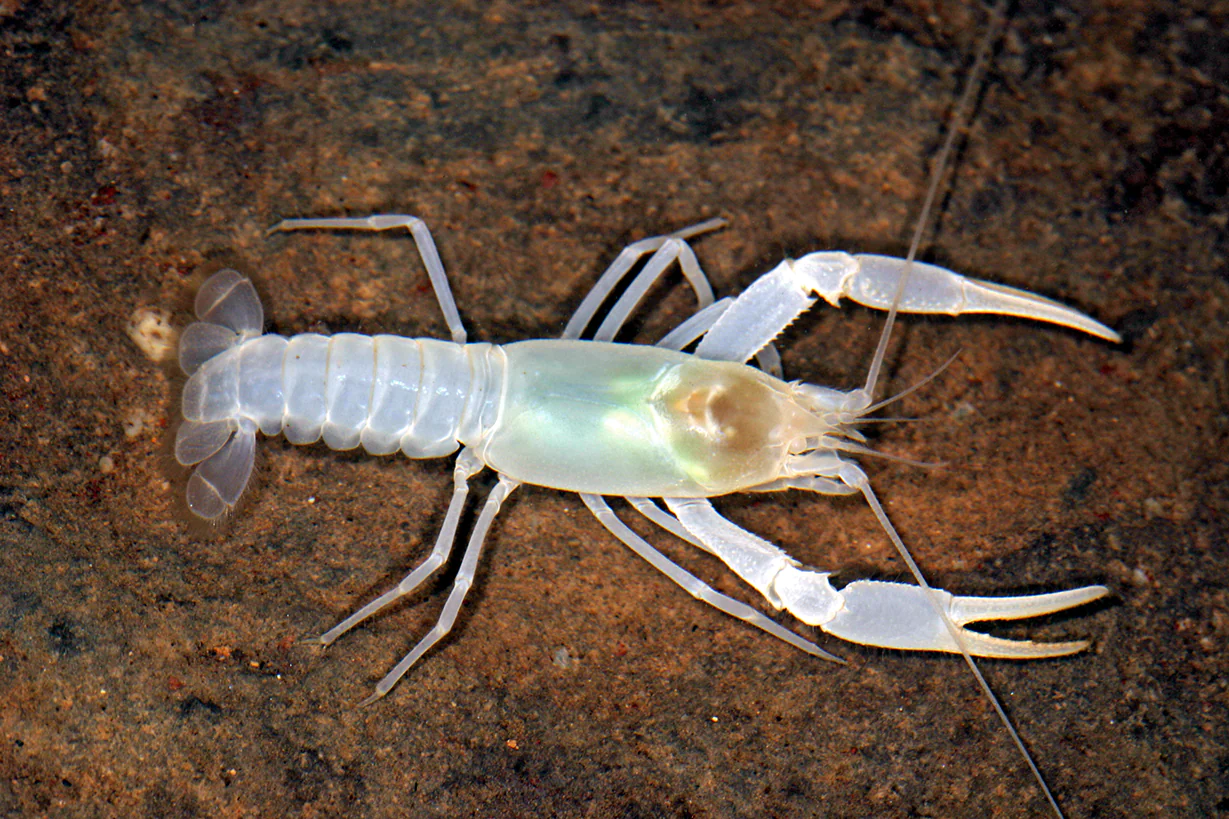
Cambarus tartarus
photo by Chris Lukhaup
Crayfish on the EDGE
Of the world’s approximately 700 species of crayfish, 70 were found to be priority EDGE species. Among those, unsurprisingly, are the smallest and largest crayfish species in the world, both found in Australia: the fingernail-sized Swamp Crayfish Tenuibranchiurus glypticus, a swamp-adapted species found in Queensland, and the Giant Freshwater Crayfish Astacopsis gouldi, found in Northern Tasmania and potentially as long as your arm!
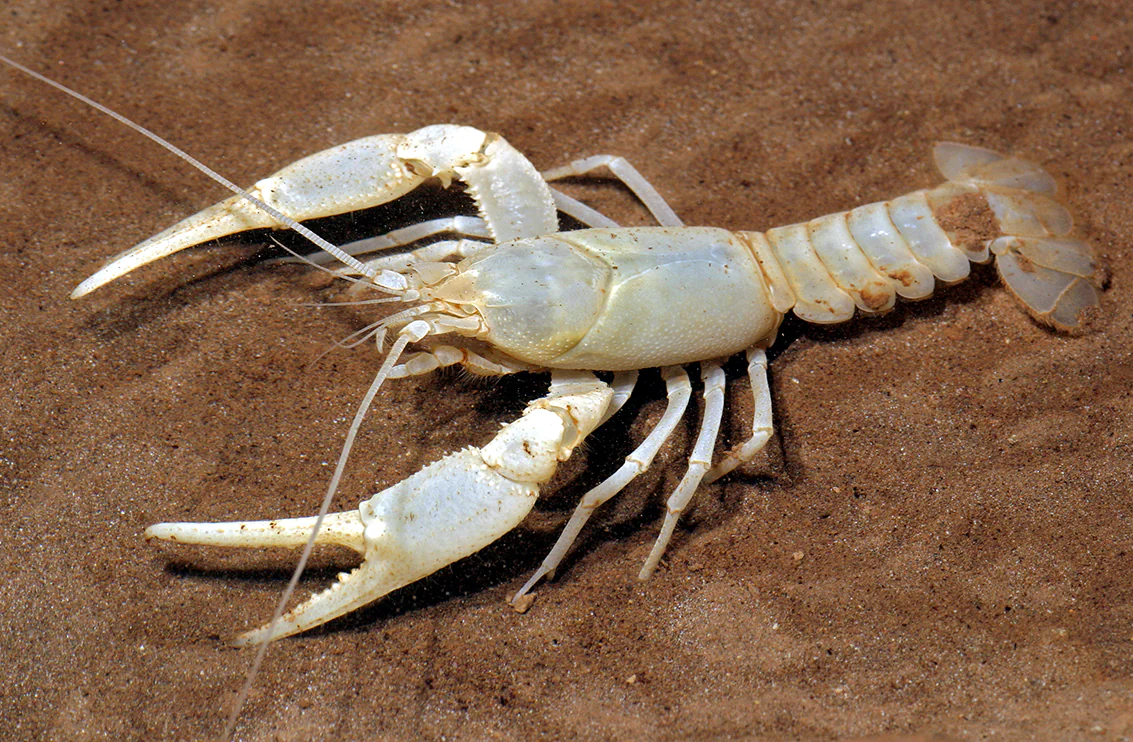
While most EDGE crayfish are from Australia, North America is home to 21 species of EDGE crayfish. Among them are the Hatchie Burrowing Crayfish Creaserinus hortoni, the Oklahoma Cave Crayfish Cambarus tartarus and the Benton County Cave Crayfish Cambarus aculabrum. These three species are both highly evolutionarily distinct and Critically Endangered, the highest extinction risk category on the IUCN Red List. Two are cave species: the Benton County Crayfish occurs in three cave systems in Benton County, Arkansas, and an upwelling in Washington County, Arkansas. The Oklahoma Cave Crayfish is found in five cave systems in the Ozark highlands in Oklahoma. Cave crayfish generally look translucent white because they often lose their pigmentation. Additionally, like other cave species, they also have reduced eyesight or are completely blind – which is not a problem when pottering around in dark caves.
Why do cave systems matter? They form critical, and often vulnerable, underground aquifers that provide drinking water and channel ground water back to surface water via springs. Cave systems also support unique ecosystems – with species like the EDGE crayfish mentioned above. Cave ecosystems are highly susceptible to pollution, making their protection crucial for water quality. In short, when cave crayfish thrive, water quality thrives!
The Hatchie Burrowing Crayfish, meanwhile, creates burrows in the ground. These can also be used by other species (other than the crayfish) as a refuge. Also, as the crayfish burrows, it shifts sediment around and oxygenates the soil. The Hatchie Burrowing crayfish is restricted to a small area in Tennessee in the Hatchie river system. It is threatened by a considerable decline in water quality that has been documented for the Hatchie river, caused by sedimentation, contaminants and alteration to its hydrology.
Crayfish are Feeling the Heat
EDGE crayfish, especially the highest scoring ones, often have very restricted ranges, just like the three species above. This is because a restricted range is also one of the symptoms (and hence an assessment criteria) for high extinction risk. Range-restricted species are limited for a reason: they generally have very specific habitat requirements, face some barrier that does not allow them to move beyond a certain range and/or they are just not great movers! This means that these range-restricted species are likely to be at a major disadvantage under scenarios of climate change. As the changing climate impacts their habitat, they are less able or unable to shift their ranges to more suitable climate and habitat conditions.
Under current high-emission climate change scenarios, the world could see a loss of up to 409 million more years of crayfish evolutionary history than would be expected as a normal part of species evolution. This means that many uniquely weird and wonderful crayfish may be lost in future!
What Can You Do to Help?
Think about what ends up in waters systems:
- avoid or limit pesticides and other pollutants in your home and garden
- reduce single-use plastic
- dispose of waste responsibly (including pet waste)
- support conservation work in your local area that benefits crayfish and other freshwater species, by volunteering, spreading the word and/or financial support
- become a citizen scientist to support vital research on crayfish and other freshwater species
- make sustainable and climate-friendly choices – shop local!
- support initiatives that help our climate
Authors: Monni Böhm, Sebastian Pipins (Imperial College London/Royal Botanic Gardens Kew), Keith Crandall (co-chair IUCN SSC Freshwater Crustacean SG), Rikki Gumbs (ZSL)
Photos by Chris Lukhaup
Published March 3, 2026