
Beyond Philanthropy
Rethinking How We Pay for Species Survival
Four weeks ago, I joined a cohort of conservation professionals from around the world at the Kinship Conservation Fellowship in Bellingham, Washington. The program is built around a simple but ambitious idea: that the environmental challenges we face won’t be solved by good intentions alone, but by leaders who can pair conservation science with the tools of markets, finance and collaborative governance. Over the month, we worked through Kinship’s core pillars of (i) adaptive leadership, (ii) iterating for scale, (iii) governing the commons, (iv) identifying an economic engine, (v) financing conservation and (vi) evaluating for impact. These pillars were established with one overarching goal: building a community of leaders who can make conservation work at the scale the crisis demands.
The centerpiece of the program is the “Fellows’ Challenge” in which small teams spend the month tackling a real, large-scale conservation problem, applying what we’re learning in real time and pitching a concrete path forward on the final day. My challenge, developed with fellow cohort members David Marneweck and Vania Olmos Lau, tackled a question I think about constantly in my work supporting IUCN Species Survival Commission National Species Specialist Groups: How do we finance the recovery of threatened species without relying almost entirely on philanthropy?
A Gap Within a Gap
During our deliberations on the challenge, I learned about the biodiversity funding gap from fellow cohort members. Looking it up, the numbers on nature finance are quite sobering. The world currently spends somewhere between $124-$143 billion a year on nature conservation, against an estimated need of up to $967 billion — leaving an annual shortfall of about $700-$800 billion (Deutz et al. 2020; UNEP Finance Initiative 2025). But within that enormous gap sits a smaller, quieter one: financing for individual threatened species. Species-specific recovery work e.g. reintroductions, anti-poaching, disease management, captive breeding etc. tends to get folded into broader climate and landscape finance conversations or overlooked entirely in favor of area-based conservation, which is “easier” to fund and measure.
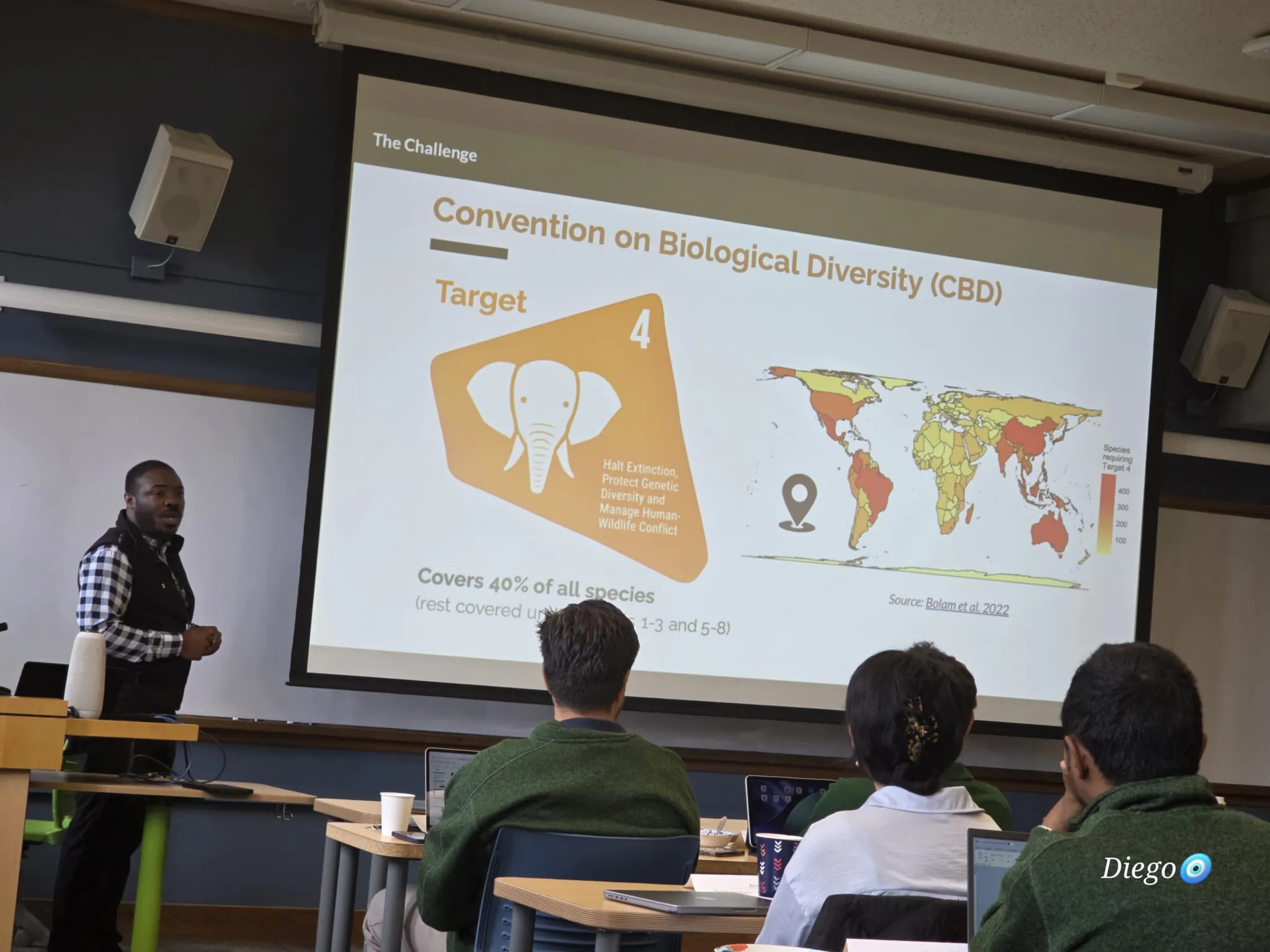
That is a problem because protecting habitat isn’t always enough. Research by Bolam and colleagues (2022) found that more than half of all threatened species, i.e. ~57%, will not see their extinction risk sufficiently reduced without targeted, species-specific action. African wild dogs are a case in point, with the situation well elucidated by David Marneweck. He argued that no protected area in Africa is currently large enough to sustain a genetically healthy population on its own, which is why recovery for the species now depends on actively managed metapopulations spanning multiple reserves — a strategy no habitat-protection budget alone was designed to fund.
Making the Case with Vultures and Pollinators
One example our team kept returning to was Old World vultures. It is easy to overlook species that most people find, frankly, a little unsettling — but vultures perform an enormous public sanitation service by rapidly consuming carcasses that would otherwise spread disease. When vulture populations in India collapsed due to a veterinary drug, researchers linked the loss directly to a rise in human mortality, with associated public health costs estimated at roughly $69 billion a year. That is not an abstract ecological argument — it’s a bill someone is already paying, whether they know it or not. Reframed that way, vulture conservation stops looking like a charity case and starts looking like a public health investment with an identifiable, paying beneficiary.
Similarly, we explored the crucial pollination service provided by several animal species that contribute to ~35% of annual crop production, with an estimated $235-$577 billion USD per year in annual market value of crop production directly attributable to these pollinators, which including several species of bees, butterflies, moths and other insects currently declining and being lost due to the excessive use of pesticides. Associated with this loss are the risks of famine and social unrest, potentially more serious but harder to quantify.
That reframing was really the heart of our project: for every threatened species, we asked not just “what does it need?” but “who benefits from its recovery, and how might they be brought in to help pay for it?”
A Framework, Not Just a Pitch
Inspired by IUCN’s own guidance on protected area finance (Meyers et al. 2025) as well as the Four Questions framework that we learned about during our sessions with Kinship Faculty member, Joshua McCarron from Everland, our team built a decision-tree framework. The decision-tree framework matches a species’ specific attributes (its range, the type of threat it faces, whether it delivers a clear ecosystem service, whether it inspires enough interest and attention i.e. is charismatic enough to anchor investor or consumer interest) to a shortlist of appropriate, non-philanthropic financing tools such as outcome-linked conservation bonds, biodiversity credits, payment-for-ecosystem-services contracts, blended finance vehicles and sovereign debt-for-nature swaps. Where a threatened species may be unlikely to meet these criteria, our decision tree recommends such species should be grouped along with other eligible species as bundled assets. Our goal wasn’t to eliminate philanthropy, but to use it strategically to derisk and unlock other capital, rather than serve as the default funding source it has become for most species work. A key underlying principle for our framework is the bundling of species assets and a blending of a portfolio of appropriate financial instruments.
We pitched this as the foundation for something bigger—a five-year roadmap toward a dedicated species-finance practice guideline and decision-support tool, and, further out, a concept we called LIONS — Legacy Investments for Our Nature Species — envisioned as the world’s largest blended-finance fund dedicated specifically to downlisting threatened species.
Why This Matters for My Work
Coming back to my role supporting National Species Specialist Groups, this challenge sharpened something I already sensed but hadn’t fully articulated: species conservation needs its own investable “product,” the way carbon and protected areas have developed over the past two decades. Until species recovery has clear financial mechanisms attached to it and not just grant applications, a majority of the world’s threatened species will keep competing for an ever-shrinking philanthropic pie.
While this may have been quite an intense, idea-dense month, I’m grateful to have worked through it alongside such a sharp, generous and resilient cohort. I am bringing these frameworks back into my work with the Specialist Groups and remain open to exploring and working on these ideas with anyone here who’s interested in how market-based tools might help fund the species we care about most.
Author: Sam Ivande, National Species Conservation Coordinator at the Global Center for Species Survival
Published August 11, 2026