
MIND.Funga Conservation Grant
Exploring the Hidden Connections Between Animals and Fungi in Southern Brazil
Fungi are actually a big deal. Through the documentary Fantastic Fungi, the public learned that fungi form mutualistic relationships with the roots of most plants, and that some compounds produced by fungi are commonly used in medications or assessed for the treatment of psychological disorders. Through TV series like The Last of Us, people now realize fungi can be parasites that can take control of, and even kill, animal hosts, although this is only known to have ever occurred in insects—not humans as shown on TV. Despite an increased awareness of fungi, many may not know that fungi can face extinction risks just like some plants and animals.
In 2024, the Indianapolis Zoo awarded a conservation grant to MIND.Funga, a research group based at the Universidade Federal de Santa Catarina. The grant was designed to launch a pioneering study of the hidden connections between animals and fungi in southern Brazil, where the group is based.
The project’s official goal was “establishing the first ex situ collection (outside of their normal habitat) of threatened fungi in Brazil and investigating how animals and fungi interact in high-altitude landscapes of the Atlantic Forest.” For conservation purposes, ex situ populations of plants and animals (like those found in zoos and botanical gardens) can be helpful to study these threatened species and potentially breed individuals to increase populations before reintroducing them into the wild. Unlike plants and animals, ex situ populations of fungi for conservation purposes are rare. In fact, few facilities exist in the world where fungi are stored specifically for conservation purposes. To be stored in an ex situ facility, known as a culture collection, fungi are isolated, grown on nutrients in a petri dish, and preserved at low temperatures.
To create an ex situ collection and study animal-fungal interactions, the team completed two expeditions in 2025, with more planned. The first expedition explored the unique ecosystems of São José dos Ausentes (Rio Grande do Sul state). The team documented a non-native slug (Meghimatium pictum) feeding on Auricularia fuscosuccinea, an edible fungus and a member of the genus often referred to as ‘wood ears.’ This observation highlighted the pressures that invasive species can place on native fungi, likely encroaching on the food supply of a native slug/snail species.
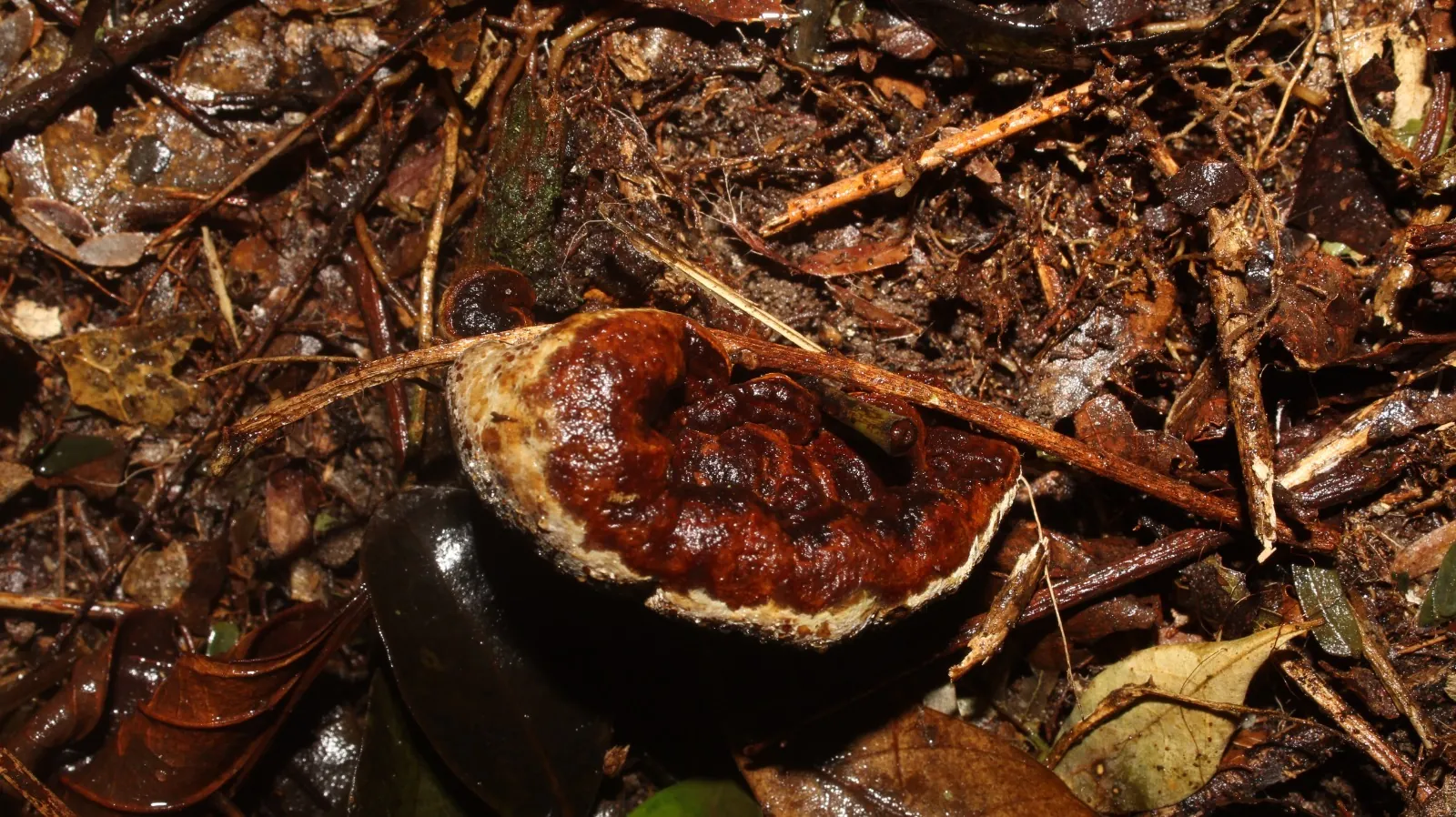
During the second expedition in Praia Grande (Santa Catarina state), the team collected 78 fungal specimens, including Fomitiporia atlantica, a large polypore or bracket fungus assessed as Near Threatened on the IUCN Red List of Threatened Species. This was only the second record of this species in Santa Catarina, and it is now preserved in the Brazilian Collection of Threatened Fungi (CFAB). The CFAB represents the first concrete ex situ conservation initiative for threatened fungi in Brazil, ensuring their genetic diversity is preserved.
To better understand animal interactions with fungi, the team deployed motion-triggered camera traps. These devices recorded 17 animal species, including forest birds such as the rufous gnateater (Conopophaga lineata) as well as small mammals like the Brazilian gracile opossum (Gracilinanus microtarsus). One recording showed a short-tailed antthrush (Chamaeza campanisona) inspecting a fungus of the genus Auricularia. Although most observations were indirect, these findings represent an initial step toward understanding how animals and fungi interact in this environment. These interactions help add to the knowledge of the interdependence of fungi and animals, such as birds that use fungi for food or nesting material—both common activities in South American forest environments.
In addition to the work done by MIND.Funga, several researchers from this group belong to the Brazil Fungal Specialist Group (BFSG). This volunteer group of conservation mycologists is one of eight specialist groups focusing on fungi within the International Union for the Conservation of Nature’s Species Survival Commission (IUCN SSC). The activities of the BFSG, and other specialist groups, are supported by the Global Center for Species Survival at the Indianapolis Zoo.
While getting fungi included in conservation policies alongside plants and animals has been a challenge, there has been recent progress in Brazil, due in large part to the members of the BFSG. At the urging of the BFSG, the Planalto Sul Action Plan, a consolidated initiative of the Brazilian government that coordinates biodiversity conservation strategies across southern Brazil, has included threatened fungal species in its action plan. This marks a milestone: fungi are finally gaining recognition within Brazil’s public conservation policies alongside animals and plants.
Both the BFSG and MIND.Funga project are pioneering the inclusion of fungi in Brazil’s biodiversity conservation agenda through their work on conservation projects in both the field and an ex situ culture collection. By unveiling the hidden links between animals and fungi, MIND.Funga hopes to inspire new approaches to conservation in the tropical regions of the Americas, including South America, Central America, tropical Mexico and the Caribbean Islands.
Photos provide by MIND.Funga. Written by MIND.Funga and edited by Fungus Conservation Coordinator, Jeffery Stallman, Vice President of Conservation & Education, Nico de Bruyn, and the Indianapolis Zoo media team.
Published November 20, 2025